What Being a Fleet Admiral Can Teach Today's Business Leaders
The Fleet Admiral commands at a scale few can imagine — dozens of vessels, thousands of crew, across vast and unpredictable theatres. Strip back the gold braid, and you find a masterclass in exactly the leadership capabilities modern business leaders need most.
Series: Leadership, Post #6
HistoricalThis post includes a Leadership Brief — an exclusive extended version.
What Being a Fleet Admiral Can Teach Today’s Business Leaders
Command at Scale — Lessons from the Admiralty That Still Hold the Line
There is a tendency in modern business literature to draw leadership lessons from the same well. Sports coaches. Silicon Valley founders. The occasional monk. But some of the most enduring, battle-tested principles of leadership come from a world few of us will ever inhabit — the command of a naval fleet. Not the romantic notion of a captain at the helm, but something altogether more complex: the Fleet Admiral, directing dozens of vessels, thousands of crew, across vast and unpredictable theatres of operation.
The rank of Fleet Admiral — or its equivalents across naval history — represents perhaps the most demanding form of command ever conceived. The decisions are strategic, the consequences irreversible, and the margin for error is measured not in percentages but in lives. And yet, when you strip back the gold braid and the signals intelligence, what you find underneath is a masterclass in the kind of leadership modern organisations desperately need.
Here’s a look at what the Admiralty can still teach us.
1. Strategic Vision Must Coexist With Tactical Awareness
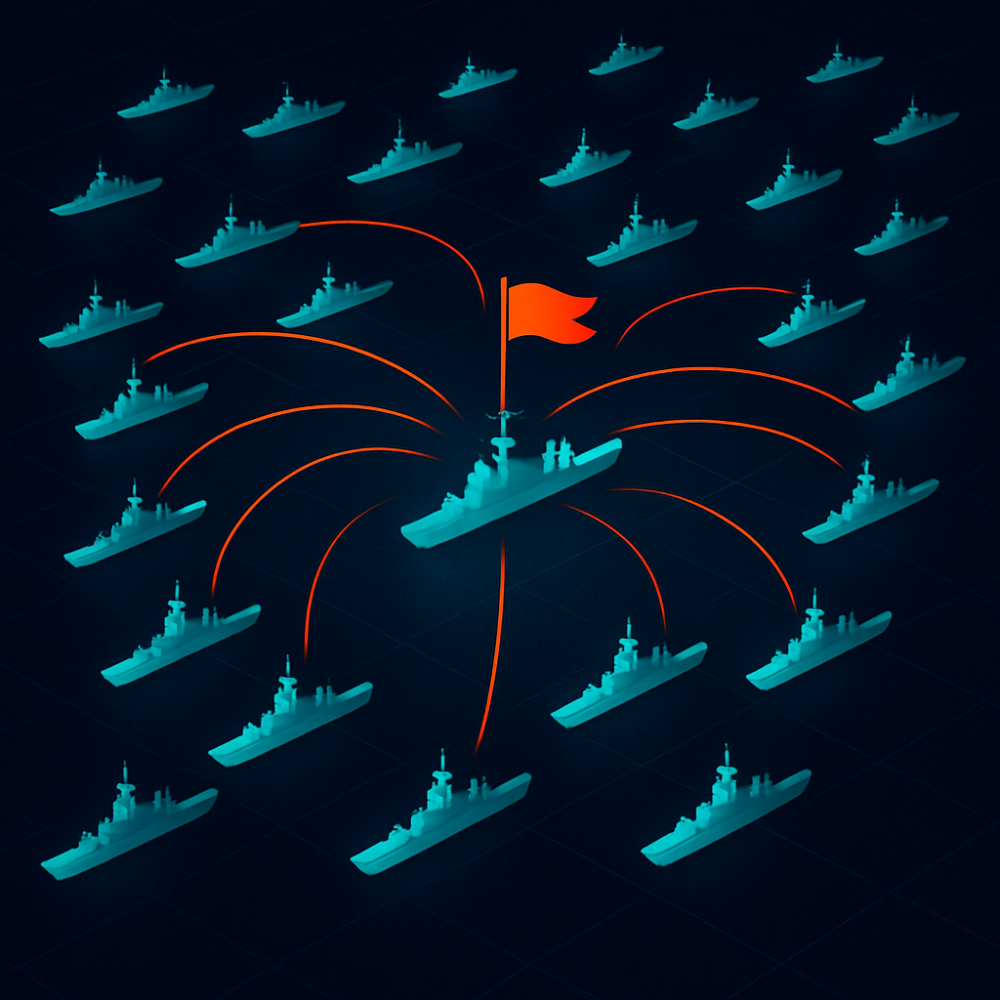
A Fleet Admiral does not steer a single ship. Their responsibility is the theatre — the entire operational picture across hundreds of miles of ocean. And yet the best Fleet Admirals in history were never so detached from the tactical reality that they couldn’t understand what was happening at hull level.
Admiral Chester Nimitz, who commanded Allied forces in the Pacific during the Second World War, is a perfect example. He operated at the grandest strategic scale whilst retaining a visceral understanding of the operational realities his commanders faced. He knew when to delegate, when to intervene, and — critically — when to trust.
For business leaders, this balance is everything:
- Operate at the right altitude. Strategy requires distance. Execution requires proximity. The skill lies in knowing which altitude is right for each situation.
- Avoid death by detail. Leaders who micromanage their fleet commanders leave the strategic picture unattended. Trust the competence you hired.
- Stay connected to frontline reality. Regular exposure to what’s actually happening in operations, service delivery, or customer interaction is not optional — it’s essential context for every strategic decision you make.
In my experience, the leaders who struggle most are often those who’ve drifted too far in one direction — either permanently in the weeds or permanently in the clouds, with no ability to shift between the two.
2. Doctrine Over Dogma — Principles Must Flex With Conditions
Naval fleets operate using doctrine: agreed principles, tactics, and procedures that allow disparate vessels to function as a coherent fighting force. But doctrine has never been the same as rigid rule-following. The greatest Fleet Admirals understood that doctrine provides the framework, not the answer, and that conditions at sea change faster than standing orders can be updated.
Admiral Horatio Nelson built what he called the “Nelson Touch” — a philosophy of aggressive initiative within a shared understanding of intent. He briefed his captains so thoroughly on his intent that they could act decisively even when signals were impossible. The result at Trafalgar was a fleet that could improvise collectively, each captain empowered to make the right call in the moment.
This is a direct ancestor of what modern organisations call Mission Command — and it is every bit as relevant in a corporate environment:
- Intent over instruction. Tell your people why and what, and let them determine how. Prescribing every step creates dependency and kills initiative.
- Shared understanding is a force multiplier. When your teams understand the overarching goal, they can navigate ambiguity without waiting for escalation.
- Update doctrine, not principles. Your processes and playbooks should evolve with market conditions. Your core values and strategic intent should not.
3. Logistics Wins Wars — and Businesses
There is a famous axiom, often attributed (perhaps apocryphally) to Napoleon: “An army marches on its stomach.” The naval equivalent is no less stark. A fleet without fuel, ammunition, food, and spare parts is simply expensive maritime furniture.
Fleet Admirals have always understood that operational brilliance on paper means nothing if the supply chain cannot sustain the effort. The Allied victory in the Pacific was as much a triumph of logistics and industrial capacity as it was of tactical ingenuity. The US Navy’s mobile service squadrons — floating repair depots that could rearm and refuel entire task forces at sea — were a strategic advantage that Japan simply could not match.
For today’s business leaders, the lesson is blunt:
- The unglamorous functions keep you in the fight. Supply chain, procurement, finance, HR — these are the logistics of business. Neglect them and your strategy stalls regardless of how clever it is.
- Resilience is a supply chain conversation. Single points of failure in your operational backbone are the business equivalent of a fleet with one fuel tanker. Stress-test your dependencies.
- Invest in the infrastructure before you need it. The time to build logistics resilience is not during a crisis.
4. Decision-Making Under Radical Uncertainty
Fog of war is not a metaphor. It is a lived reality for every commander at sea — imperfect intelligence, delayed communications, conflicting reports, and an enemy who is actively trying to deceive you. Fleet Admirals cannot wait for certainty before acting. Certainty, in most operational contexts, arrives too late to be useful.
Admiral Raymond Spruance, commanding at the Battle of Midway, made several critical decisions based on incomplete information. He chose when to launch, when to withdraw, and when to hold — each time without the full picture. What he possessed, however, was a clear framework for decision-making: an understanding of his own capabilities, his opponent’s likely intent, and the acceptable level of risk at each juncture.
This translates directly to the boardroom and the operations centre:
- Define your decision framework before the crisis arrives. What are your red lines? What risk tolerance do you have? These conversations are much harder to have in the moment.
- Distinguish between reversible and irreversible decisions. Naval commanders reserve their greatest deliberation for decisions they cannot undo. Apply the same logic to your own choices — not every decision warrants the same cognitive overhead.
- Act on the best available information, not perfect information. Waiting for certainty is itself a decision — often the worst one.
5. The Human Element: Morale, Welfare, and the Crew
No Fleet Admiral wins a campaign without their crew. And every great naval commander in history has understood that the human dimension — morale, wellbeing, trust, and loyalty — is not a soft consideration. It is a hard operational variable.
Admiral Andrew Cunningham, who commanded the Royal Navy’s Mediterranean Fleet during some of the most brutal naval warfare of the Second World War, was famous for his concern for the men under his command. When asked during the evacuation of Crete whether the risk to the fleet was worth taking to rescue the Army, he reportedly said:
“It takes three years to build a ship. It takes three hundred years to build a tradition.”
Whether apocryphal or not, the sentiment is profound. The culture, the tradition, the morale of a fighting force is more durable — and more valuable — than any single asset.
For business leaders:
- Your people are not resources — they are the capability. The moment you treat them as interchangeable units, you begin eroding the very thing that makes your organisation effective.
- Morale is a leading indicator. Engagement drops before performance does. By the time it shows in your KPIs, the cultural damage is already significant.
- Visible leadership matters. Fleet Admirals who visited ships, spoke to ratings, and were seen by their crews built a different kind of loyalty. Being present as a leader — genuinely present, not just in a town hall — still matters enormously.
6. After-Action Review: The Tradition of Learning Under Fire
The Royal Navy has maintained a tradition of the Board of Inquiry and the Post-Action Report for centuries. When something goes wrong — or right — it is examined. Systematically. Without sentimentality. The lessons are codified and fed back into doctrine. It is, in modern parlance, a continuous improvement culture baked into the institutional DNA.
This is not natural to most organisations. Post-mortems feel uncomfortable. Retrospectives get cancelled when the project runs over. The pressure to move on to the next thing is relentless.
But the Fleet Admiral knows that unexamined failure is the precursor to repeated failure:
- Build learning rituals into your cadence. Not as a bureaucratic obligation, but as a genuine commitment to organisational improvement.
- Create psychological safety for honest review. If people fear the debrief, they will sanitise it. The value of after-action review is entirely dependent on its honesty.
- Capture what worked as well as what didn’t. Positive lessons are just as valuable, and just as frequently lost.
7. Coalition Command: Leading People Who Don’t Report to You
Perhaps the most underappreciated challenge of Fleet Admiral-level command is the management of coalition forces. Allied naval operations in both World Wars required the coordination of multiple nations’ fleets, each with their own doctrine, culture, communication styles, and chain of command. You cannot simply order a French destroyer captain the same way you order one of your own. Influence, relationship, and shared purpose must do the work that rank alone cannot.
This is increasingly the reality for business leaders. Matrix organisations, outsourced services, strategic partners, joint ventures, and contracted suppliers mean that authority structures are rarely as clean as the org chart suggests. The ability to lead through influence — to build coalitions, align incentives, and create genuine shared purpose — is a critical and often underdeveloped skill.
- Understand what motivates each party. Coalition leadership requires you to see the world from each partner’s perspective, not just your own strategic interest.
- Invest in relationships before you need them. The allied commanders who worked best together had usually built trust in peacetime exercises. Don’t wait for a crisis to develop your key partnerships.
- Shared mission is the glue. When the common goal is clear and compelling, coordination across boundaries becomes significantly easier.
Conclusion
The Fleet Admiral stands at an extraordinary intersection of strategic vision, operational mastery, human leadership, and institutional resilience. They command at a scale and complexity that would paralyse most leaders — and they do so under conditions of genuine uncertainty, with consequences that cannot be undone.
The lessons they embody — balancing altitude, enabling initiative, sustaining the logistical backbone, deciding under uncertainty, caring for people, learning relentlessly, and leading without authority — are not period pieces from the age of sail. They are exactly the capabilities that modern business leaders need to develop if they are to navigate an environment that is, in its own way, just as unpredictable and unforgiving as the open ocean.
The question worth sitting with is a simple one: if your organisation were a fleet, what kind of Admiral would you be?
What Commanding a Fleet Can Teach Today’s Business Leaders
What a single decision at Midway reveals about leading at scale and under fog
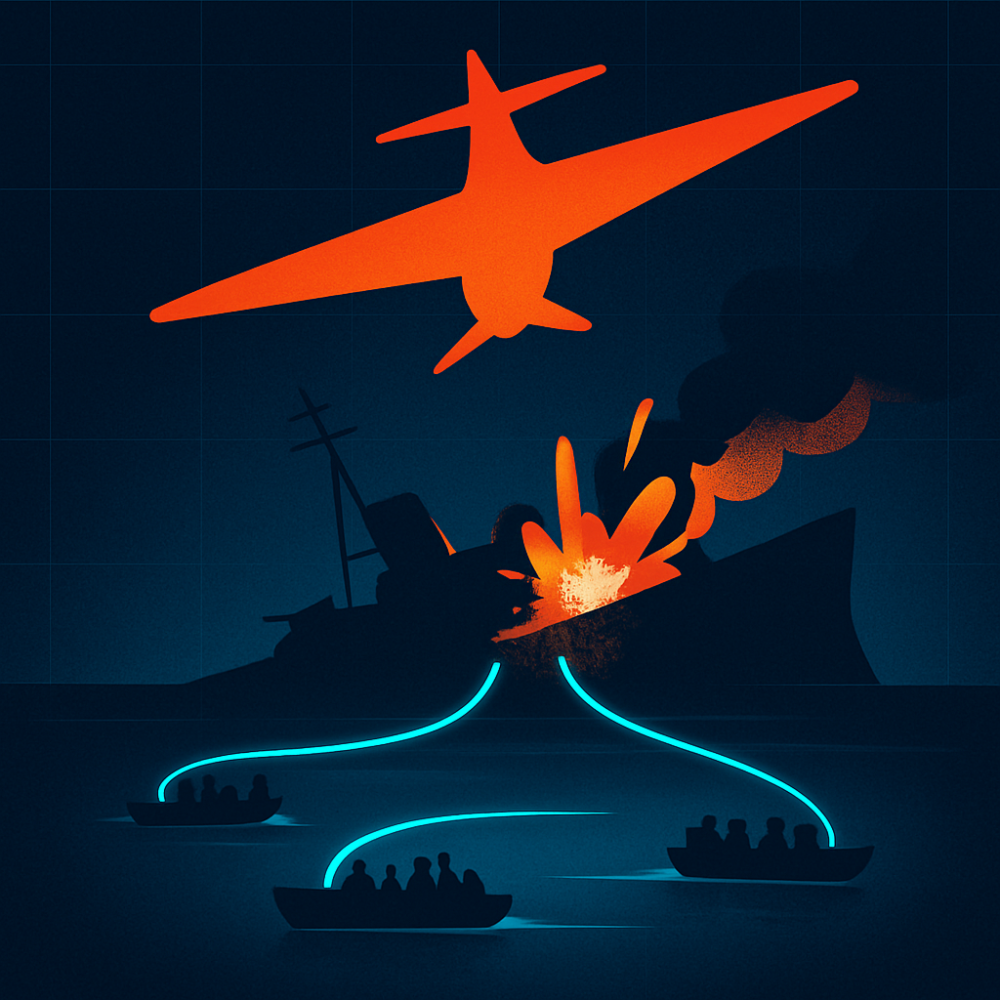
On the morning of the 4th of June 1942, a rear admiral named Raymond Spruance stood on the flag bridge of the carrier Enterprise and made a decision that he could not undo, on the basis of information he knew to be incomplete, with the balance of a war in the Pacific resting on whether he had read the situation correctly.
He was not, by background, the obvious man to be making it. Spruance was a cruiser commander who had been handed a carrier task force only days earlier, when the admiral who should have held the role fell ill. Carrier aviation was not his speciality. What he had instead was a clear head, a careful temperament, and an understanding — rare among commanders and rarer still under pressure — of exactly what he knew, what he did not know, and what he was prepared to risk on the gap between the two. Scout planes had located part of the Japanese carrier force. The enemy’s aircraft were believed to be away, striking at Midway and not yet returned. There was a window — perhaps an hour, perhaps less — in which the Japanese carriers might be caught with their decks full of rearming, refuelling aircraft, at their most catastrophically vulnerable. To exploit it meant launching everything, immediately, at the edge of his aircraft’s fuel range, committing his strike before he could be certain of the enemy’s exact position or strength. To wait for certainty meant the window would close.
He launched. The strike that followed found the carriers in precisely the state he had gambled on, and within a few minutes of concentrated dive-bombing the course of the Pacific war turned. Had he been wrong about the timing, he would have flung his aircraft into empty ocean, exhausted their fuel, and left his own carriers exposed to a counterstrike. He knew that. He launched anyway, because he understood something that sits at the heart of command at scale: certainty, in most operational situations that matter, arrives too late to be of any use, and the leader’s job is not to wait for it but to act well in its absence.
I have come to believe that fleet command — not the romantic image of a captain at a wheel, but the genuine article, an admiral directing dozens of vessels and thousands of people across hundreds of miles of unforgiving ocean — is one of the most underused sources of leadership wisdom available to us. We draw our management lessons from the same shallow well: the sports coach, the start-up founder, the occasional monk. Meanwhile the admiralty offers a tradition, refined over centuries under the most demanding conditions imaginable, of leading at a scale and complexity that would paralyse most modern executives, with consequences measured not in percentage points but in lives and in the fate of nations. Strip away the gold braid and what remains underneath is a body of hard-won principle about how to lead when you cannot see the whole board, cannot personally control most of what matters, and cannot take any of it back. Spruance’s morning is where I want to start, because almost everything that makes fleet command instructive is visible in that one decision and in the kind of man it took to make it.
Notice, first, the altitude at which he was operating. Spruance was responsible for the entire theatre — the strategic picture across a vast expanse of ocean — and yet his decision turned on a visceral, almost tactile grasp of operational reality: how long the enemy’s aircraft would take to rearm, what his own pilots could do at the limit of their range, what an hour’s delay would cost. This is the central balancing act of command at scale, and it is the one most senior leaders get wrong, usually by drifting permanently to one pole or the other. Some rise into the strategic clouds and lose all feel for what is actually happening at hull level, issuing direction untethered from the reality their people are living. Others never leave the weeds, micromanaging the tactical detail their subordinates should own whilst the strategic picture drifts, unattended, towards disaster. The great fleet commanders could move between altitudes at will — distant enough to see the whole theatre, connected enough to understand the deck. Chester Nimitz, who ran the entire Pacific campaign, was famous for it: operating at the grandest strategic scale whilst retaining a genuine understanding of the conditions his commanders faced, and — crucially — knowing when to delegate, when to intervene, and when simply to trust. The skill is not in choosing a comfortable altitude and staying there. It is in knowing which altitude each situation demands, and being able to shift.
The trust I have just mentioned is not vague good feeling; in fleet command it has a precise mechanism, and it is one I think modern organisations badly need to recover. A fleet cannot be run by signal alone. Communications fail, are intercepted, arrive too late, or are impossible to send in the heat of an engagement, which means a fleet that can only act on explicit orders from the top is a fleet that freezes the moment the orders stop coming. The solution, developed most famously by Nelson and now taught under the name mission command, was to brief subordinate commanders so thoroughly on the intent — the why and the what — that they could act decisively on their own judgement when no instruction was possible. Before Trafalgar, Nelson gathered his captains and explained his thinking so completely that when the battle dissolved into smoke and signals became useless, each captain could improvise in service of a plan they understood from the inside. The result was a fleet that acted as one mind distributed across many ships, every captain empowered to make the right call in the moment because every captain knew what the moment was for.
The translation to organisational life is almost exact, and it is the principle I would press hardest on any leader who finds their people forever waiting for sign-off. Tell them why and what; let them determine how. Prescribe every step and you build dependency, kill initiative, and create an organisation that stalls the instant you stop transmitting. Build genuine shared understanding of the intent and you create teams that can navigate ambiguity without escalating every decision upward — which is the only way an organisation of any size moves at speed. This is also where the distinction between doctrine and dogma earns its keep. A fleet runs on doctrine: agreed principles and procedures that let disparate vessels function as a coherent whole. But the great commanders never confused doctrine with rigid rule-following. Doctrine was the framework, not the answer; conditions at sea changed faster than standing orders could be rewritten, and the captain who followed the letter of an order into a situation it was never designed for was as dangerous as the one who ignored orders entirely. The lesson for organisations is to hold the distinction clearly: your processes and playbooks should evolve constantly with conditions, whilst your core intent and values stay fixed. Update the doctrine freely. Do not mistake it for the principle underneath.
There is a part of fleet command that never appears in the dramatic retellings, and it is the part that actually determines who wins. A fleet without fuel, ammunition, food and spare parts is not a fighting force; it is expensive maritime furniture, drifting and useless however brilliant its tactics on paper. The Allied victory in the Pacific was, as much as anything, a triumph of logistics — and the single sharpest illustration is the mobile service squadron, a fleet of floating repair and supply ships that could rearm and refuel an entire task force at sea, keeping it in the fight far from any home port. Japan had no equivalent and could not build one, and that unglamorous asymmetry shaped the campaign as decisively as any battle. The lesson for business is blunt and unwelcome: the functions nobody celebrates are the ones that keep you in the fight. Supply chain, procurement, finance, the operational backbone — these are the logistics of an organisation, and the most elegant strategy in the world stalls the moment they cannot sustain it. Resilience, in particular, is a logistics conversation: a single point of failure in your operational core is the business equivalent of a fleet with one fuel tanker, and the time to build that resilience is emphatically not during the crisis that exposes its absence.
For all the systems and supply lines, fleet command remained inescapably a matter of people, and the best commanders understood the human dimension as a hard operational variable rather than a soft consideration. Andrew Cunningham, who commanded the Royal Navy’s Mediterranean fleet through some of the most brutal naval warfare of the war, captured it during the evacuation of Crete. Asked whether the risk to his ships was worth running to rescue the soldiers trapped ashore, he is supposed to have said that it takes three years to build a ship and three hundred years to build a tradition — and whether or not the words are exactly his, the judgement is profound. The culture and morale of a fighting force is more durable, and more valuable, than any single asset, and it is built in part by the simple, costly act of a commander being seen to value the people under them. For business the principle holds without modification. Your people are not interchangeable resources; they are the actual capability, and the moment you treat them as fungible units you begin eroding the very thing that makes the organisation effective. Morale, moreover, is a leading indicator — engagement falls before performance does, which means by the time the decline shows up in your metrics the cultural damage is already done. And visible leadership still matters: the admirals who walked the decks and spoke to their crews built a loyalty that no message from a distant flag bridge could manufacture.
That same naval tradition built something else worth stealing — a culture of learning under fire so institutionalised that it has run for centuries. When something went wrong, or right, the Royal Navy examined it: systematically, without sentiment, through the board of inquiry and the post-action report, and it fed the lessons back into doctrine. This is continuous improvement baked into institutional DNA, and it is harder to replicate than it sounds, because it runs against every instinct under pressure. Post-mortems are uncomfortable. Retrospectives are the first thing cancelled when the project overruns. The pull to simply move on to the next thing is relentless. But unexamined failure is the precursor to repeated failure, and the value of an honest review depends entirely on its honesty — if people fear the debrief, they will sanitise it, and a sanitised debrief teaches nothing. The organisations that learn fastest are the ones that build genuine learning rituals into their cadence, create enough safety that the review can be truthful, and remember to capture what worked as carefully as what failed, because positive lessons are just as valuable and just as frequently lost.
The final challenge of fleet command is, to my mind, the most modern of all, and it is one most leaders now face whether they have noticed or not. Allied naval operations required the coordination of multiple nations’ fleets — different doctrines, different cultures, different chains of command — and you cannot simply order a French destroyer captain the way you order one of your own. Coalition command is leadership through influence rather than authority, accomplished through relationship and shared purpose because rank alone does not reach across the boundary. This is now the daily reality of business. Matrix structures, outsourced services, strategic partners, joint ventures, contracted suppliers — the authority structures are almost never as clean as the org chart pretends, and a great deal of what you need done sits with people who do not report to you and never will. Leading them requires the coalition commander’s skills: understanding what genuinely motivates each party rather than assuming your own priorities are shared, investing in the relationships before the crisis rather than during it, and making the common mission clear and compelling enough that coordination across the boundary becomes possible. The allied commanders who worked best together had almost always built their trust in peacetime exercises, long before they needed it. The lesson transfers cleanly: do not wait for the crisis to develop the partnerships the crisis will demand.
Spruance, for what it is worth, was as composed in victory as he had been in the decision. He did not chase the retreating enemy recklessly into the night, where a counterstroke might have undone everything; he weighed the irreversible against the reversible, secured what he had won, and declined the gamble that pride would have urged. That, too, is the mark of command at the highest level — the discipline to know which decisions can be taken back and which cannot, and to reserve your deepest deliberation, and your willingness to walk away from a tempting risk, for the ones that cannot.
Conclusion
The fleet commander stands at an extraordinary intersection of strategic vision, operational mastery, human leadership and institutional resilience, directing a scale and complexity that would overwhelm most leaders, under genuine uncertainty, with consequences that cannot be undone. The disciplines they embody are not relics of the age of sail. Move deliberately between altitudes. Lead through intent so your people can act when you cannot reach them. Hold your doctrine loosely and your principles firmly. Honour the logistics that keep you in the fight. Treat morale as the hard variable it is. Learn from every engagement, honestly. And lead the people who do not report to you through influence and shared purpose. If your organisation were a fleet, the question worth sitting with is a simple one — and it is not whether you could command it, but what kind of commander, in the fog and under fire, you would actually turn out to be.