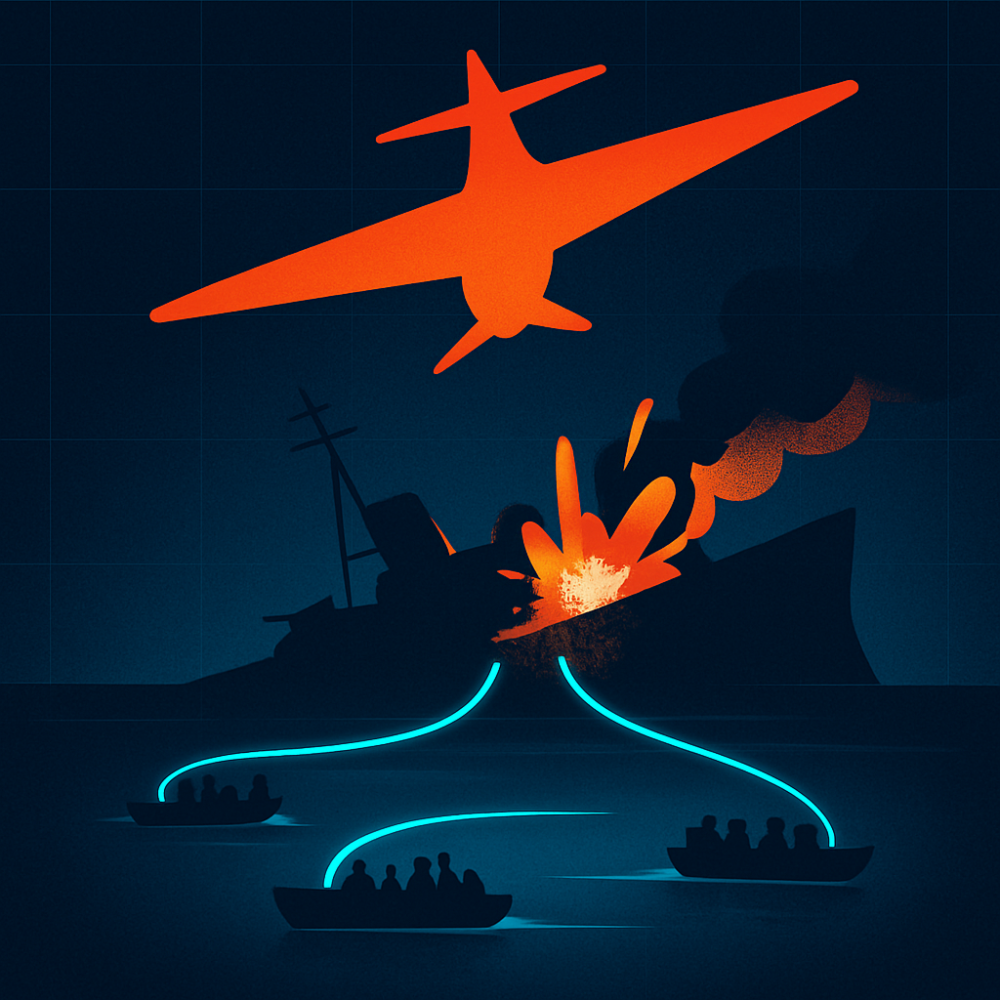
The General Who Distrusted Generals
The most powerful soldier of his age trusted almost nothing — not his plans, not his ego, not even the machine he commanded — and that disciplined distrust is exactly what our move-fast era of leadership has forgotten.
Series: Unconventional Leadership, Post #14
HistoricalThis post includes a Leadership Brief — an exclusive extended version.
What Dwight Eisenhower Can Teach Today’s Business Leaders
Planning Is the Point. The Plan Is Not.
Eisenhower spent months planning D-Day. The plan started falling apart within hours of the first landings. What survived wasn’t the document — it was the shared understanding embedded into every officer who had lived inside the planning process. They knew the intent well enough to make good decisions when the original design no longer applied.
That’s the only useful function of planning. Not prediction. Not certainty. The process of thinking hard enough about the objective that your people internalise it so thoroughly they can execute without the plan. If your team can only function with the slide deck in front of them, the planning failed.
Eisenhower didn’t treat the plan as the deliverable. He treated the thinking as the deliverable, and the plan as proof the thinking had happened. That distinction — between the plan and the planning — is one most leaders never make.
The Objective Is Not Your Status
Supreme Commander of the Allied Forces in Europe. He could have worn that title like armour. Instead, Eisenhower spent much of the war managing Montgomery’s ego, smoothing Patton’s blunders, absorbing Churchill’s impatience, and keeping De Gaulle from torpedoing the coalition entirely.
None of that is glamorous. None of it appears in the highlights reel. All of it was the job.
Frustration with managing upwards and sideways is almost always a symptom of confusing your role with your status. Eisenhower’s status was extraordinary. His role, day to day, was to be the person willing to do what nobody else wanted to do: coalition maintenance, political cover, interpersonal buffer. He did it because the mission required it, not because it reflected well on him.
If you want to lead large, complex things, make your peace with the fact that your most important work will frequently be invisible.
Make the Call. Then Commit Completely.
When the weather window opened for D-Day — narrow, risky, far from ideal — Eisenhower didn’t agonise publicly. He made the call and backed it fully. No hedging. No pre-positioning his defence if it went wrong.
Most leaders in genuinely uncertain situations make a decision and then immediately start managing their exposure to being wrong. They hedge publicly. They build the opt-out before they’ve fully entered the commitment. They prepare the narrative that explains why it wasn’t really their call. Eisenhower understood that a decision made tentatively isn’t really a decision — it’s a provisional statement that leaks uncertainty downward through the entire organisation.
Make the call. Then act as though you mean it. Your people are watching whether you believe it yourself.
Beware the Machine You’ve Built
Eisenhower’s farewell address warned America about the military-industrial complex — the vast institutional structure he had spent his career building and directing. He’d seen at close range how an apparatus created to serve an objective could quietly become an objective in itself.
The dynamic is universal. The processes, reporting structures, and institutional habits you build to serve the strategy have a way of outlasting their purpose. They optimise for their own continuation. They generate work that justifies their existence. At some point, the machine starts directing the strategy rather than the other way around.
The leader’s job isn’t just to build capable structures — it’s to keep asking whether those structures still serve what they were built for, or whether they’ve quietly become the point. That question doesn’t get easier when the machine is your achievement. It gets harder. Ask it anyway.
The General Who Distrusted Generals
What Dwight D. Eisenhower Understood About Power That Most Business Leaders Never Will
On the morning of 5 June 1944, the most powerful military commander on Earth sat in a trailer in southern England and did nothing. The weather was foul. The forecast was a coin-toss. A hundred and fifty thousand men were waiting on his word, and the word he gave was wait. Then, hours later, on a meteorologist’s fragile hunch that a gap might open in the storm, Dwight D. Eisenhower said four words — “OK, let’s go” — and launched the largest invasion in human history.
What strikes me about that moment isn’t the courage, though there was plenty. It’s the restraint that came before it. Eisenhower was a man who had spent his life inside systems of enormous power, and who trusted almost none of them — not the plans, not the machinery, not even, ultimately, the institution he served. That distrust is the thread that runs through everything he did, and it is precisely the quality our era of confident, disruptive, move-fast leadership has forgotten. We celebrate leaders who believe in their own momentum. Eisenhower’s genius was that he never quite believed in anything — and built his decisions accordingly.
Here is what that bought him, and what it could buy you.
1. He Distrusted the Plan — Which Is Why His Plans Worked
“Plans are worthless, but planning is everything.” It’s his most quoted line and his most misread. People hear a paradox. Eisenhower meant something sharper: the document is a liability the moment you start believing it.
Consider what he was actually doing in the months before D-Day. He wasn’t building a plan to follow. He was building a team that understood the problem so intimately that they could throw the plan away under fire and still move as one. And throw it away they did — within hours of landing, the carefully sequenced timetable was in ruins, units scattered, objectives missed. The invasion succeeded anyway, because the planning had done its real job: it had turned a roadmap into instinct.
This is the part most leaders get exactly backwards. They treat the strategy deck as the deliverable — polish it, present it, defend it. And the more effort goes into the artefact, the more emotionally committed everyone becomes to a thing that reality is about to dismantle. The deck becomes a hostage. Pivoting feels like admitting failure rather than doing the obvious.
The Eisenhower move is to hold the output with open hands and guard the understanding with your life. Ask of any plan: if this document vanished tomorrow, would my team still know what to do? If the answer is no, you haven’t planned. You’ve just decorated a guess.
2. He Subordinated His Ego — Because the Coalition Was the Strategy
Here’s the uncomfortable thing about Eisenhower: as a battlefield tactician, he was unremarkable. Patton was bolder. Montgomery was, by his own loud account, superior at everything. Eisenhower’s actual gift was the one we systematically undervalue — he could hold a room of brilliant, vain, competing people together long enough to win a war.
And what a room. He spent 1944 refereeing Montgomery and Patton’s mutual contempt, soothing Churchill, managing Roosevelt, placating de Gaulle, and somehow keeping the British and Americans pointed at Germany rather than each other. He did it through a method that runs directly against modern executive instinct: he absorbed blame, deflected credit, let other men feel like the cleverest person in the conversation, and quietly got his way while they were still congratulating themselves.
There’s a deeper point here, and it’s the spine of why Eisenhower matters to business. We’re taught to see strategy and politics as separate things — the strategy is the real work, and the people-management is the tax you pay to execute it. Eisenhower understood that in any complex organisation, the coalition is the strategy. The most elegant plan dies the moment the people meant to carry it stop trusting each other. The org chart tells you who reports to whom; it tells you nothing about who would walk through fire for whom, and that second map is the only one that moves anything.
Which is why the leader who needs their name on every win is quietly sabotaging themselves. Every drop of credit you hoard is a drop of loyalty you forfeit. Eisenhower spent his ego freely so he’d have it to spend when it counted — and almost no modern executive has the security to copy him.
3. He Owned the Failure Before It Happened
Now return to that trailer on the eve of the invasion, because Eisenhower did one more thing there that I find almost impossible to imagine a modern leader doing. He took out a pad and wrote a second statement — the one to be released if the landings failed. It is a few sentences long. It blames no one. It cites no contributing factors. It says, with brutal simplicity, that the decision was his and the fault was his alone: “If any blame or fault attaches to the attempt it is mine alone.”
He then folded it into his wallet and carried it through the longest day of his life. He never needed it. But he had written it before he knew the outcome — which is the entire point, and the thing that separates real accountability from its corporate imitation.
Because here is what actually happens in most organisations. Accountability is assigned retroactively, after the result is known, and it flows downhill. The leader waits to see how things land before deciding whose fault it was — and somehow it’s rarely theirs. We have built an entire grammar for this: the passive-voice apology (“mistakes were made”), the blame diffused across “the team,” the post-mortem that finds process failures but never people.
Eisenhower’s note is a standing rebuke to all of it, and it asks every leader a question that genuinely stings if you sit with it. Not would you take the blame after a failure — most people manage that once it’s unavoidable. The question is: would you write it down beforehand, in your own hand, when success was still a live possibility and you could so easily have left yourself an exit? Most of us already know the answer, and the knowing is uncomfortable. It should be.
4. He Acted on Coin-Tosses — and Then Stopped Thinking
We’ve circled the D-Day decision three times now, which is deliberate, because everything about Eisenhower converges on it. Strip away the history and look at the raw shape of the moment: incomplete information, irreversible stakes, a forecast no better than even, and a closing window. There is no framework on Earth that resolves that cleanly. At some point analysis runs dry and a single human being has to simply decide.
What I want to highlight isn’t that he decided — it’s what he did after. The order given, he didn’t agonise. He didn’t reconvene the meteorologists for one more read. He didn’t hedge or stage a partial commitment to keep his options open. He went to visit the paratroopers who were about to jump, and then he waited. The deliberation was total right up to the decision, and then it was over. Energy that had gone into deciding went entirely into committing.
This is the discipline almost everyone fails, and they fail it in one of two directions. Some never reach the decision at all — they mistake endless deliberation for diligence, gathering one more data point while the window quietly closes, because not-deciding feels safer than deciding wrong. Others decide but never commit — they keep one foot on the platform, hedging and re-litigating, so that the organisation can feel the leader’s doubt and never fully moves. Eisenhower did neither. He understood that a decision and the commitment to a decision are two separate acts, and that making the first without the second is just elaborate procrastination.
Perfect information is never coming. The leaders who matter are the ones who can act decisively on a coin-toss and then close the door behind them — and most of the paralysis we dress up as “rigour” is simply the fear of having to do exactly that.
5. He Distrusted Even His Own Machine
And then there’s the moment that, to me, elevates Eisenhower from great commander to genuinely wise man. In January 1961, leaving the presidency, this five-star general — a man who had spent his entire life inside the American military — used his farewell address to warn the nation against the “military-industrial complex.” He cautioned that the vast permanent machinery of defence, with its own budgets and incentives and momentum, could grow beyond democratic control and start serving itself rather than the country.
Sit with the strangeness of that. The most decorated soldier of his age, at the height of the Cold War, chose his final public words to warn against the very system that had made him. It would have been so much easier — and so much more comfortable — to issue a stirring call to vigilance against the external enemy. Instead he turned and pointed at the machine behind him.
This is the rarest leadership quality of all, and the one our moment needs most desperately. Eisenhower understood that systems develop their own gravity. The structures, incentives and technologies we build to serve a purpose eventually start reshaping behaviour toward purposes no one chose. He saw it in defence procurement. We can see it everywhere now — in engagement algorithms optimising for outrage no one wanted, in surveillance infrastructure built for safety and repurposed for control, in the breathless deployment of artificial intelligence by leaders who can describe what it does and have plainly never once asked what it will become once it has scale, inertia, and a balance sheet depending on it.
The leaders history will judge kindly are not the ones who built the biggest, fastest machine. They are the ones who had the intellectual honesty to look at their own creation and ask, out loud and against their own interest, what is this going to do once it’s too large to stop? That is the hardest sentence a powerful person can say. Eisenhower said it on his way out the door, and we are still failing to listen.
The Common Thread
Step back and the six lessons collapse into one. Eisenhower distrusted the plan, so he built understanding instead of documents. He distrusted his own importance, so he spent his ego buying loyalty. He distrusted the comfortable instinct to dodge blame, so he wrote his name on the failure in advance. He distrusted the seduction of more analysis, so he decided on coin-tosses and committed without looking back. And he distrusted the machine he himself commanded, so he warned the world about it on his way out.
Every one of those is a refusal to be carried by momentum — and momentum is the exact thing our era of leadership worships. We celebrate the founder who believes, the executive who disrupts, the visionary so certain of the future that they’ll break the present to reach it. Eisenhower is the standing argument against all of it. His power came not from belief but from a disciplined, clear-eyed refusal to be swept along by anything — not his plans, not his pride, not his own colossal machinery.
That’s not a soft skill. It’s the hardest discipline in leadership, and it’s vanishingly rare precisely because everything about power pushes the other way. So here is the question Eisenhower leaves on the table, and it’s worth answering honestly. When the storm is closing in and the window is shrinking and every instinct is screaming at you to either freeze or charge — can you do the harder thing? Can you hold the plan loosely, swallow your ego, own the risk in advance, decide on the coin-toss, and still keep one clear eye on what you’re building?
Or, put the way he’d have put it: when it’s your turn in the trailer, and the forecast is a coin-toss, and the word is yours — what exactly are you going to say?