ITIL® 4 vs ITIL® (Version 5): Key Differences Explained
A breakdown of the key differences between ITIL® 4 and ITIL® (Version 5), what has changed, and what it means for practitioners and organisations.
ITIL® 4 vs ITIL® (Version 5): Key Differences Explained
ITSM · 25 April 2026 · 10 min read
The ITSM world rarely stands still, and January 2026 brought with it one of the biggest moments in the framework's history: the official release of ITIL® (Version 5). If your inbox has looked anything like mine over the past few months, you will have noticed no shortage of opinions — some proclaiming wholesale revolution, others dismissing it as little more than a cover refresh. In my view, the truth sits usefully in between, and it is well worth understanding exactly what has changed before making any decisions about your certification path or your organisation's ITSM strategy.
This article covers the key differences between ITIL® 4 and ITIL® (Version 5), what remains the same, and what it all means in practice. Whether you are an ITSM practitioner, a team lead, or someone considering their certification options, there should be something useful here for you.
1. The Big Picture: A Shift in Scope
Perhaps the most important thing to understand about ITIL® (Version 5) is what it is now about. ITIL® 4 was fundamentally a framework for IT Service Management. Version 5 expands that scope considerably to encompass Digital Product and Service Management (DPSM).
ITIL® 4 vs Version 5 — at the highest level:
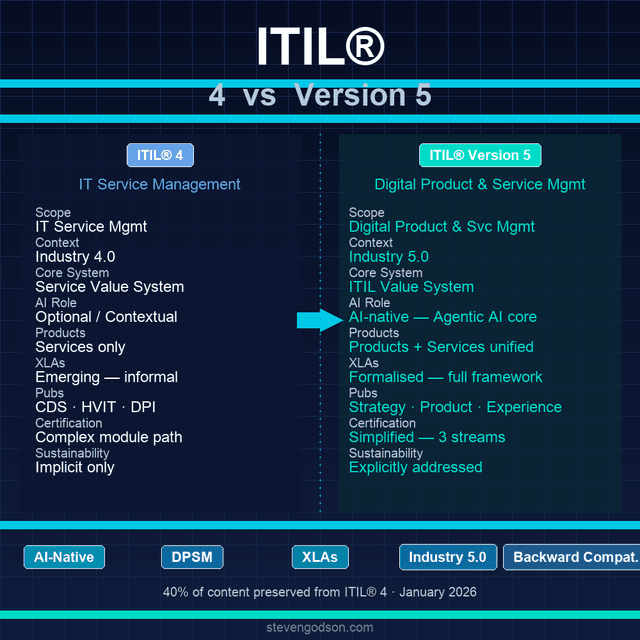
- Scope — ITIL® 4 covered IT Service Management (ITSM). Version 5 covers Digital Product & Service Management (DPSM).
- Industrial context — ITIL® 4 aligned with Industry 4.0. Version 5 aligns with Industry 5.0.
- Focus — ITIL® 4 addressed services only. Version 5 addresses products and services together in a unified lifecycle.
This is not merely semantic housekeeping. It reflects a genuine shift in how modern organisations operate. Most organisations today do not deliver services in isolation — they deliver digital products and services together, and the old distinction was creating real gaps in practice. ITIL® (Version 5) unifies them into a single, end-to-end lifecycle.
There has long been a call to drop the "IT" element from IT Service Management, since the framework applies well beyond IT departments. Version 5 recognises this: its courses are explicitly aimed at every business utilising digital services, not purely IT teams.
2. What Has Remained the Same
Before we explore the changes, it is worth acknowledging what PeopleCert has deliberately preserved — and why this matters if you already hold ITIL® 4 certifications.
- The 7 Guiding Principles: These remain intact and unchanged. Focus on value, start where you are, progress iteratively with feedback — they are as relevant in 2026 as they were in 2019.
- The Four Dimensions of Service Management: Organisations & People, Information & Technology, Partners & Suppliers, and Value Streams & Processes — all present, with only minor terminology updates.
- The Service Value Chain: The core mechanism of the SVS remains, connecting demand to value through its six activities.
- All 34 ITIL Practices: Every one of the 34 management practices carries over, with only minor updates to terminology to reflect modern approaches. No practices have been removed.
- ITIL Foundation as the entry point: Foundation remains the mandatory starting point for all advanced certifications, and — importantly — your existing ITIL 4 Foundation certificate still counts.
- Backward compatibility: PeopleCert has been explicit that existing ITIL investments are protected. Your certifications carry forward.
Roughly 40% of the framework content is preserved from ITIL® 4. The remaining 60% has been updated, restructured, or introduced as genuinely new material. This is not a minor revision — but it is a coherent evolution, not a reset.
3. Key Differences at a Glance
Here is how the two versions compare across the areas that matter most:
Scope and context
- Scope — ITIL® 4: IT Service Management / Version 5: Digital Product & Service Management (Updated)
- Industrial context — ITIL® 4: Industry 4.0 / Version 5: Industry 5.0 (Updated)
- Core value framework — ITIL® 4: Service Value System (SVS) / Version 5: ITIL Value System (ITIL VS) (Renamed)
What's new
- AI governance — ITIL® 4: not addressed / Version 5: dedicated ITIL AI Governance publication (New)
- Automation & AI — ITIL® 4: optional and contextual / Version 5: AI-native; agentic AI a core concept (New)
- Customer experience — ITIL® 4: SLAs / XLAs emerging / Version 5: Experience Level Agreements (XLAs) formalised (New)
- Sustainability — ITIL® 4: implicit only / Version 5: explicitly addressed within the framework (New)
What has expanded
- Product management — ITIL® 4: services only / Version 5: products + services in a unified lifecycle (Expanded)
- Terminology — ITIL® 4: standard ITSM vocabulary / Version 5: XLA, agentic AI, observability, SRE, DPSM added (Expanded)
- Publications — ITIL® 4: Create, Deliver & Support; High Velocity IT; etc. / Version 5: Strategy, Product, Service, Experience, Transformation, AI Governance (New set)
What has been simplified or preserved
- Foundation exam — ITIL® 4: ~42.5% on practice workflows / Version 5: 0% on detailed practice workflows (Revised)
- Certification scheme — ITIL® 4: complex module structure / Version 5: practitioner modules bundled into PM certifications (Simplified)
- 34 Practices — both versions: all 34 present, minor terminology updates only (Preserved)
- Guiding Principles — both versions: all 7, completely unchanged (Unchanged)
4. AI-Native by Design
If I were to identify the single biggest philosophical shift in Version 5, it would be this: AI is no longer an afterthought. In ITIL® 4, artificial intelligence and automation were contextual topics — acknowledged, but not woven into the fabric of the framework. In Version 5, they are core.
- Agentic AI: Version 5 introduces "agentic AI" as a formal concept — autonomous AI agents that act on behalf of organisations and users, not just surface-level chatbots.
- ITIL AI Governance: A dedicated publication and standalone certification covering responsible AI adoption, ethical governance, and oversight frameworks — entirely new in Version 5.
- Observability: Observability and Site Reliability Engineering (SRE) principles are formalised as part of the vocabulary and practice, reflecting how modern digital operations actually run.
- Automation as standard: Automation is treated as a normal part of how work is managed, not an optional add-on. Manual, unscalable approaches are explicitly noted as inadequate for digital-first organisations.
In my opinion, this is a genuinely positive development. For years, ITSM practitioners have been navigating AI adoption without adequate framework guidance. The creation of a dedicated ITIL AI Governance publication is long overdue, and should provide a much-needed structure for organisations deploying AI into their service operations.
5. A New Vocabulary to Learn
One of the most concrete impacts of Version 5 — particularly if you are studying for Foundation — is the significant expansion of the framework's vocabulary. The Foundation exam now tests terminology at nearly three times the weighting of ITIL® 4 (30% vs 12%).
Key terminology changes to be aware of:
- Service Value System (SVS) is now the ITIL Value System (ITIL VS)
- Service Level Agreement (SLA) is joined by the formalised Experience Level Agreement (XLA)
- Service Management is now framed as Digital Product & Service Management (DPSM)
- Service Value Chain expands into the Product & Service Lifecycle
- New terms introduced: Agentic AI, Observability, and Site Reliability Engineering (SRE)
If you are studying for the Foundation exam using ITIL® 4 materials, this is where you will feel the gap most acutely. The new vocabulary is not incidental — it reflects substantive changes in how the framework conceptualises digital operations.
6. The Foundation Exam Has Changed Significantly
This one catches people out. The ITIL® (Version 5) Foundation exam is not a minor update to the ITIL® 4 paper. The weighting has shifted considerably:
Detailed practice workflows
- ITIL® 4 Foundation: ~42.5%
- ITIL® (Version 5) Foundation: 0%
Key concepts and terminology
- ITIL® 4 Foundation: ~12%
- ITIL® (Version 5) Foundation: ~30%
Service / ITIL Value System
- ITIL® 4 Foundation: ~18%
- ITIL® (Version 5) Foundation: ~22%
Guiding Principles
- ITIL® 4 Foundation: ~17%
- ITIL® (Version 5) Foundation: ~18%
In ITIL® 4, the Foundation exam tested your knowledge of seven specific practices in considerable depth — incident management, change control, service desk operations, and so on. In Version 5, that detailed practice knowledge has been moved to the advanced certifications, where it genuinely belongs. The Foundation level now focuses on framework fluency, vocabulary, and strategic understanding. Honestly, that is a sensible restructuring.
7. New Publications Structure
Version 5 introduces a completely new set of core publications, replacing the ITIL® 4 books (Create, Deliver & Support; High Velocity IT; Direct, Plan & Improve; etc.).
Core publications
- ITIL Foundation (Version 5) — Entry-level framework overview and prerequisite for all advanced modules.
- ITIL Strategy (New) — Organisational direction and digital strategy for products and services.
- ITIL Product (New) — End-to-end digital product management alongside service delivery.
- ITIL Service (New) — Service management operations, practices, and continual improvement.
- ITIL Experience (New) — Customer and user experience, XLAs, and stakeholder value realisation.
Additional publications
- ITIL Transformation (New) — Guiding organisations through digital and service transformation.
- ITIL AI Governance (New) — Responsible AI adoption, ethics, oversight, and agentic AI management.
8. The New Certification Pathway
The qualification scheme has been simplified and restructured. Practitioner modules no longer exist as standalone certifications — they are now bundled into Practice Manager certifications. There are nine core modules plus one extension module, organised into three learning streams.
The pathway works from the bottom up:
- ITIL Foundation (Version 5) — the mandatory starting point for all advanced certifications.
- Three professional designations, each with their own stream of modules:
- ITIL Managing Professional — for those with a business and operational focus.
- ITIL Strategic Leader — for those working at strategy and direction level.
- ITIL Practice Manager — for those who need deep practice-level expertise.
- ITIL Master — awarded on completion of all three designations.
In addition, ITIL AI Governance is available as a standalone extension module with no Foundation prerequisite required.
9. If You Already Hold ITIL® 4 Certifications
The question I am already hearing most frequently is: "What do I need to do with my existing ITIL® 4 certifications?" The short answer is: nothing urgent. Your certifications remain valid. Transition pathways are designed to respect your existing investment.
- ITIL 4 Foundation → Fully recognised as ITIL Foundation (v5). No further exam needed.
- ITIL 4 Managing Professional → Bridge module available for ITIL Managing Professional (v5).
- ITIL 4 Strategic Leader → Bridge module available for ITIL Strategic Leader (v5).
- ITIL 4 Practice Manager → Updated bundled pathway available for ITIL Practice Manager (v5).
- ITIL 4 Master → Structured transition pathway — speak to an Accredited Training Organisation (ATO).
My preference when advising practitioners: if you are close to completing an ITIL® 4 certification path, see it through — the knowledge is still entirely relevant. If you are starting fresh, I would recommend going directly to Version 5. It is the most complete and up-to-date starting point available, and there is little to be gained from beginning a journey that will require bridging in the near future.
10. What This Actually Means in Practice
Framework releases can sometimes feel abstract — especially when you are deep in the day-to-day of running a service desk or managing a change advisory board. So let me be direct about what Version 5 means on the ground.
- If your organisation manages digital products alongside services — Version 5 finally gives you a framework that reflects how you actually work. The unified lifecycle removes an artificial boundary that has caused real operational friction.
- If you are deploying AI into your service operations — the ITIL AI Governance publication will provide a meaningful governance structure. This is the first time ITIL has addressed AI with the seriousness the topic demands.
- If you are running an ITSM transformation programme — the new Transformation publication should be directly useful, providing structured guidance for navigating change rather than leaving practitioners to improvise.
- If your focus is on customer and user experience — the formalisation of Experience Level Agreements (XLAs) is a welcome development. XLAs have been emerging in practice for several years; it is good to see them given proper framework-level status.
- If you are training your team — the simplified certification structure makes it easier to build a coherent learning pathway. Fewer standalone modules, clearer streams.
I am always conscious that frameworks only deliver value when they are actually applied. The question is never purely "what does Version 5 say?" but rather "how do we embed this thinking into how our teams work day-to-day?" The expanded scope and restructured publications of Version 5 should make that application more straightforward — but the real work, as ever, will be done by practitioners.
11. A Brief History of ITIL®
- 1980s — ITIL v1: Developed by the UK government's CCTA to standardise IT service management across departments. Originally 31 volumes.
- 2007–2011 — ITIL v3 and 2011 Refresh: A five-volume lifecycle framework covering Service Strategy, Design, Transition, Operation, and Continual Service Improvement. The global standard for a generation.
- 2019 — ITIL® 4: A significant redesign introducing the Service Value System, Four Dimensions, 34 Practices, and alignment with Agile, Lean, and DevOps.
- January 2026 — ITIL® (Version 5): Expands scope to Digital Product & Service Management, introduces AI-native governance, and aligns with Industry 5.0. Backward compatible with ITIL® 4.
Conclusion
ITIL® (Version 5) is a meaningful and well-considered evolution of the framework. It is not a revolution — the foundations remain solid — but it is a genuine step forward in addressing how digital organisations actually operate in 2026 and beyond.
The expansion to Digital Product and Service Management, the AI-native approach, the formalisation of XLAs, and the simplified certification pathway all reflect real-world practice rather than theoretical tidying. In my opinion, that is exactly what a framework update should do.
Whether you are updating your certifications, advising your organisation, or simply keeping up with the profession, the changes in Version 5 are worth understanding properly — not as an academic exercise, but as a practical lens through which to view your ITSM work.
Hopefully this has been useful to you and I wish you well on your ITSM journey…
© 2026 Steven Godson · stevengodson.com
ITIL® is a registered trademark of the PeopleCert group. Used under licence.


Comments
Loading...